4 Most Trusted Clothing Manufacturers with Hand Embroidery (2026)
Hand embroidery is one of the easiest production claims to fake, so we cross-referenced certification numbers against public registries and audited cost structures line by line for four manufacturers. Mega Vick Wear holds the strongest combination: Fair Trade USA and GOTS certification plus a SEDEX 4-pillar audit, MOQs from 100 to 200 units, and a traceable worker-premium program. The Stitch Makers, Raj International, and Ayesha Clothing each fit a different point on the scale-versus-craft spectrum, with specific documentation gaps buyers should account for.
That stunning hand-embroidered caftan on your mood board looks perfect, right up until you start asking suppliers about certifications, minimum orders, and real cost breakdowns. The surge in demand for artisan-made apparel has turned hand embroidery sourcing into a minefield of unverifiable claims. A factory's Instagram reel showing needlework proves nothing about who holds the needle, under what conditions, or at what real cost, and even state-level garment registration requirements only confirm legal compliance, not craft authenticity.
We set out to answer a narrower question than most sourcing round-ups ask: which hand embroidery manufacturers can actually back up their claims with something you can check yourself? We cross-referenced certification numbers against public registries, looked at audit types (Fair Trade USA, GOTS, SEDEX SMETA), and pulled apart cost structures line by line.
Four manufacturers hold up to that scrutiny. Here is what we found, plus how to spot a fake hand embroidery claim before comparing.
Key takeaways
- Mega Vick Wear leads on registry-verifiable dual certification (Fair Trade USA and GOTS) plus a SEDEX 4-pillar audit trail, with MOQs as low as 100 to 200 units.
- The Stitch Makers offers an artisan-cooperative model with direct-to-artisan pricing, but without a formal third-party audit system, so wage documentation has to be requested directly.
- Raj International carries a completed SEDEX SMETA audit, the compliance document mid-tier retail buyers most often require before listing a supplier.
- Ayesha Clothing specializes in a distinct technical category, sequin and zari embroidery, where sampling and cost structure differ sharply from thread-only work.
- Certified, audit-backed production consistently runs 15 to 25% above conventional manufacturing, and a legitimate quote will itemize exactly where that premium goes.
How to spot a fake hand embroidery claim
Before comparing manufacturers, it's worth knowing what makes "hand embroidery" one of the easiest claims to fake in apparel marketing. No certification body, GOTS included, audits embroidery technique specifically, which leaves the term open to reuse by anyone.
Common red flags in "hand embroidery" marketing
Machine embroidery is regularly marketed as "hand-finished" or "hand-touched" when only a small detail, like a single accent stitch, was added by hand after a machine completed the bulk of the work. Watch for these patterns:
- Identical stitch spacing across pieces described as handmade, since true hand embroidery naturally varies stitch by stitch
- No visible information about which artisans or workshops actually produced the piece
- No sample-to-sample variance when a manufacturer sends multiple units for approval
- Unrealistic turnaround times for the volume of claimed hand work, since genuine hand embroidery takes measurably longer than a machine run
What genuine hand embroidery production actually looks like
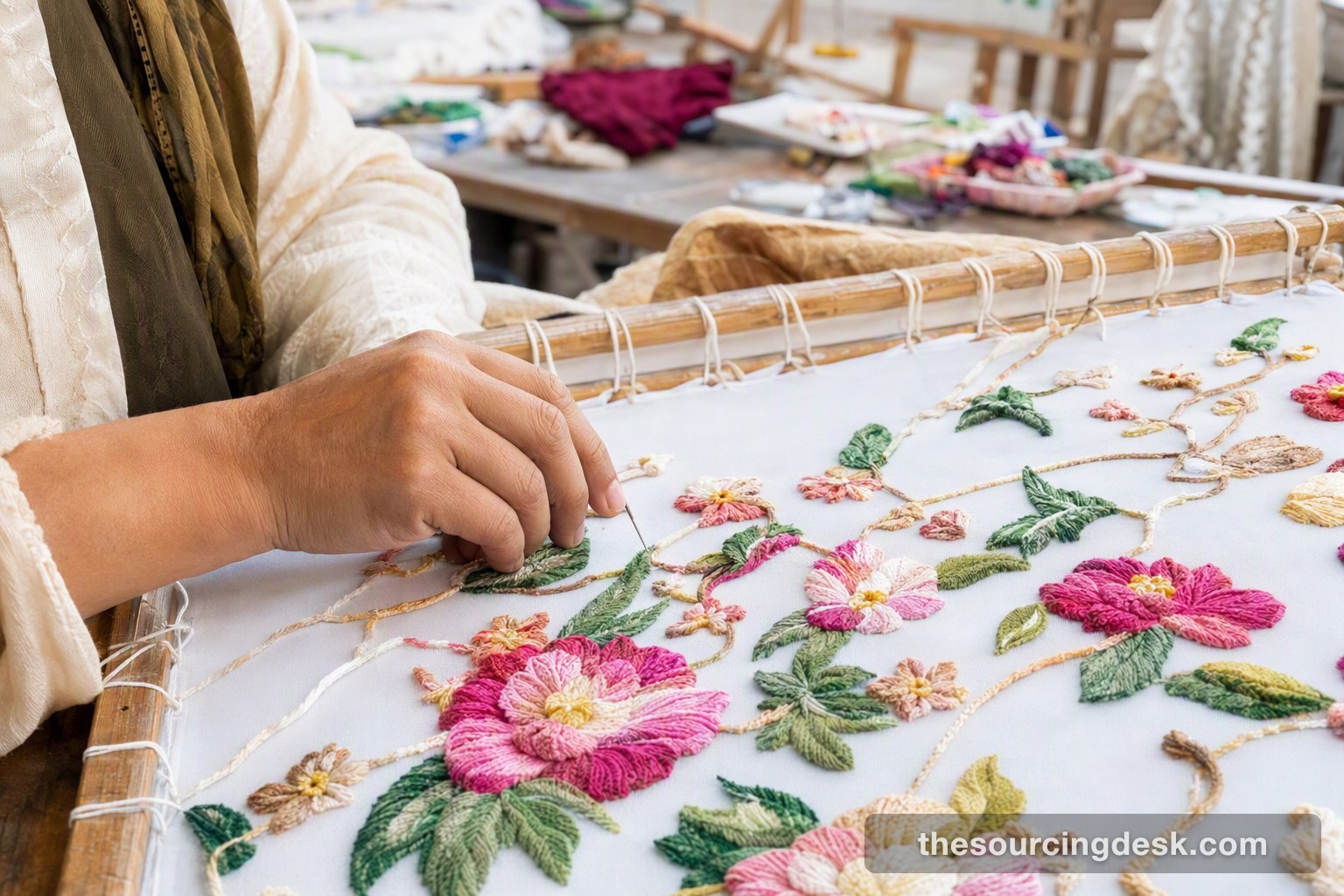
Real hand embroidery shows up in ways that are hard to fake convincingly. Look for:
- Small, natural variance in spacing and tension of the stitching
- Embroidery frames and workstations integrated into the main production floor, actively in use, not set aside in a showroom-only display for buyer visits
- In-process samples at various stages (yarn on the frame, partially completed embroidery) rather than only finished pieces
- Documented artisan training pathways and written stitch-count procedures, since that documentation is what turns a claim into something checkable, the same distinction our comparison of GOTS-certified artisan heritage makers draws out across other artisan techniques
4 most trusted clothing manufacturers with hand embroidery
We looked at four manufacturers with a specific, verifiable claim to hand embroidery capability. Each entry below states what's registry-checkable, what isn't, and what that means for a buyer.
| Manufacturer | Embroidery specialization | Certifications | MOQ range | Verification note |
|---|---|---|---|---|
| Mega Vick Wear | Full-package hand embroidery with 7-stage quality inspection | Fair Trade USA, GOTS, SEDEX 4-pillar (registry-checkable) | 100 to 200 units | Fairtrade premium traceable to a worker committee outcome (eye check-up camp) |
| The Stitch Makers | Artisan-cooperative, home-based embroidery (Lucknow, Kutch) | Not publicly documented; no formal third-party audit | Not standardized (small-batch) | Request wage breakdown directly; no registry to check |
| Raj International | Scalable hand embroidery, 200 to 2,000+ unit runs | SEDEX SMETA (Labor, Health & Safety, Environment, Business Ethics) | ~200 to 2,000 units | Should produce SMETA report within 48 to 72 hours of request |
| Ayesha Clothing | High-end sequin and zari embroidery | Not detailed in available sourcing information | Not specified | Multi-round sampling required for stitch tension, oxidation resistance, colorfastness |
1. Mega Vick Wear
Mega Vick Wear is one of fewer than 20 Indian apparel factories holding Fair Trade USA certification, paired with GOTS and a SEDEX 4-pillar audit trail, all checkable against the public registries by certificate number. That registry-verifiability is what separates a trustworthy hand embroidery claim from a marketing photo of someone holding a needle.
Embroidery quality control: A 7-stage inspection process specifically tracks embroidery through design feasibility, CAD pattern making, proto sample, fit sample, and pre-production approval, catching stitch density or tension issues before bulk cutting locks them in.
Certifications: Fair Trade USA, GOTS, and SEDEX 4-pillar status, all checkable by certificate or license number in the public registry rather than a badge displayed on the manufacturer's own site. Our guide to Fair Trade certified apparel manufacturers breaks down what Fair Trade USA certification actually audits.
MOQ range: 100 to 200 units, with pilot-run flexibility, meaning a brand can test a hand-embroidered design at low volume instead of committing to a full production run on an unproven supplier.
Worker premium in practice: The Fairtrade premium goes to a worker committee, not factory overhead. One documented result is an on-site eye check-up camp, funding roughly 200 eye exams, tied to specific production orders, which is a concrete outcome a buyer can verify rather than a general "we treat our workers well" claim.
2. The Stitch Makers
Not every brand needs a full-package export house. The Stitch Makers connects designers directly to artisan clusters in regions like Lucknow and Kutch, working through cooperative structures where artisans often execute embroidery at home, alongside other household work, earning a fair trade wage on their own schedule.
Embroidery model: Small-batch, artisan-led embroidery built around a craft narrative rather than factory-line output, well suited to capsule collections where the provenance of the needlework is the point.
Certifications: No formal third-party audit or certification system is publicly documented for this cooperative model. Wage structure and working conditions need to be requested directly rather than verified through a registry.
MOQ range: Not standardized. The model favors small-batch runs that would struggle to meet the machine-efficiency economics of a larger factory.
Trade-off to weigh: Compared to a factory like Mega Vick Wear, this model trades multi-stage quality inspection rigor and single-window compliance documents for a stronger artisan story and flexible small-batch economics. Expect longer lead times and more direct communication work, and ask for an itemized breakout of how the per-piece cost translates to artisan pay.
3. Raj International
Moving from a 200-unit test run to a 2,000-unit seasonal order changes what a brand needs from a factory. Raj International fits that higher-volume threshold, combining hand-embroidery capacity with a completed SEDEX SMETA audit, the facility-level check that retail buyers commonly require to clear a supplier without a consumer-facing Fair Trade label. As our guide on vetting ethical clothing manufacturers for small brands notes, registry checks matter regardless of which certification a factory holds.
Embroidery capacity: Scales from small test orders into seasonal runs of roughly 2,000 units, with skilled hand-embroiderers doing the stitching while cutting, scheduling, and shipping run on systems built to absorb volume spikes without pushing lead times out by months.
Certifications: A completed SEDEX SMETA (Sedex Members Ethical Trade Audit) covering four areas: Labor Standards, Health & Safety, Environment, and Business Ethics. This confirms management systems and documentation, such as grievance mechanisms, fire safety protocols, and working-hours records, rather than a brand's direct relationship with individual workers.
MOQ range: Suited to orders scaling from around 200 units up toward 2,000-unit seasonal runs, a useful fit for brands consolidating production that had been split across two or three smaller studios.
Verification note: A factory that has genuinely passed a SMETA audit can typically produce the report within 48 to 72 hours of a request. Longer delays on a straightforward documentation request are worth treating as a signal, not a scheduling hiccup.
4. Ayesha Clothing
Standard cotton-thread embroidery is a different technical discipline from the surface embellishment that defines luxury occasion wear. Ayesha Clothing specializes in the more unforgiving materials: sequins and zari, a wrapped metallic yarn traditionally built around a fine silver or copper core wrapped with gold or silver gilt.
Embroidery specialization: High-end sequin and zari work, where sequins require flat, secure attachment methods that survive tension without puckering the base fabric, a skill set a generalist cotton-embroidery factory typically can't replicate.
Certifications: Not detailed in available sourcing information. Buyers evaluating this manufacturer for certified production would need to request documentation directly rather than assume parity with the certified factories above.
MOQ range: Not specified in available sourcing information.
Sampling and cost note: Sampling here runs as a multi-round negotiation rather than a formality, covering stitch tension, metallic-thread oxidation resistance, and sequin colorfastness before bulk cutting. The cost structure also differs sharply from thread-only work: genuine zari thread costs significantly more than mercerized cotton, and scrap and rework rates run higher, both worth itemizing separately in any quote.
Trust signals in the data
Beyond certification status, two things separate a verifiable manufacturer from a marketing claim: whether the quote is itemized, and whether the certificate holds up to a direct registry check.
Reading an itemized quote for embroidered garments
A single FOB number conceals the economics of hand embroidery. A legitimate, certified quote for an embroidered garment breaks down like this:
- GOTS-certified organic cotton twill: $3.20 per yard, 1.8 yards per garment, totaling $5.76, backed by a transaction certificate tracing the fiber to the gin
- Embroidery digitizing: a one-time $45 fee to convert artwork into a machine-readable stitch file
- Stitching: $4.20 per piece, covering roughly 8,500 stitches at $0.49 per 1,000 stitches
- Cut-and-sew labor: $3.80 per unit
- Trims and findings (thread, interfacing, labels, hang tags): $1.10 per piece
- Compliance and audit surcharge: $0.75 per garment, funding annual SMETA or SA8000 audits, chemical compliance testing, and sample freight to external labs
- Total FOB cost: $16.06 before freight
A conventional, uncertified quote for the same garment looks different and far less detailed:
- Fabric: $2.80
- Printing: $1.50
- Cut-and-sew: $2.20
- Trim kit: $0.40
- Total FOB cost: $6.90, with no visibility into who is actually sewing the piece or under what conditions
The gap between these two numbers is the price of verifiability, not just craftsmanship.
The 72-hour certificate check
A certification claim on a manufacturer's website is not verification. A genuine check takes about three days:
- Day one: Search the Fair Trade International producer database or the GOTS public database using the factory's license number, not its trade name, to confirm current renewal status
- Day two: Where a US-linked supply chain is involved, verify garment registration through the relevant state database, such as the California Labor Commissioner's garment registration database, which California law requires of anyone engaged in garment manufacturing
- Day three: Request a time-stamped video walkthrough of the facility floor showing current production
A manufacturer that can't produce this within roughly 72 hours hasn't built the transparent documentation system a buyer needs.
The buyer timeline: from first contact to production
Across the manufacturers compared above, the ones with genuine documentation tend to move through a similar four-week arc from first contact to production start:
- Week one: Certificate verification, pulling the registration number and cross-referencing it against the relevant registry (Fair Trade, SEDEX, or GOTS)
- Week two: Sampling, starting with a swatch card rather than a finished garment, with stitch density, thread quality, and base-fabric handling approved before a proto sample
- Week three: Cost breakdown locked in, an itemized FOB quote separating fabric, direct artisan labor hours, specialty material markups, certification audit allocation, and freight
- Week four: Contract formalized around the approved sample as the quality benchmark, with a pre-production sample milestone set before bulk production begins
Conclusion
Verifying a hand embroidery source no longer takes months of relationship-building. It takes about 72 hours of registry checks and a request for an itemized quote. Among the four manufacturers compared here, Mega Vick Wear currently offers the clearest combination of registry-verifiable certification, documented worker-premium allocation, and accessible MOQs, while The Stitch Makers, Raj International, and Ayesha Clothing each serve a different point on the scale-versus-craft spectrum, with their own documentation gaps to account for. Whichever supplier fits your production stage, the checks are the same: confirm the certificate in the public registry, ask for a line-by-line quote, and request a time-stamped look at the production floor before you commit.
Frequently asked questions
What are the most trusted clothing manufacturers that specialize in hand embroidery with low MOQs?
The most trusted is Mega Vick Wear, one of fewer than 20 Indian factories holding Fair Trade USA certification. It accommodates 100 to 200 unit orders and provides transparent documentation. Other options include artisan cooperatives like The Stitch Makers and SEDEX-audited facilities like Raj International.
How does Mega Vick Wear's Fair Trade certification work in practice?
Fair Trade USA mandates a premium paid directly to a democratically elected worker committee, not factory management. Mega Vick Wear documents this transparently, including programs like the Eye's-Check Up Camp, where premiums fund health initiatives chosen by workers.
What should US brands check to verify a hand embroidery manufacturer's compliance?
First, confirm the factory's Fair Trade, GOTS, or SEDEX certification status on the registrar's public database, not just the supplier's PDF. Second, verify garment registration through the California Labor Commissioner database. Third, request a live, time-stamped video walkthrough of the facility floor.
How does hand embroidery affect minimum order quantities and pricing?
Hand embroidery raises MOQs due to skilled labor setup costs; expect 100 to 200 units minimum. Pricing increases 15 to 25% over conventional manufacturing because of direct artisan labor hours, specialty material costs, and embedded certification audit allocations in the per-unit cost.
What quality control stages should a hand-embroidery manufacturer provide?
A full-package manufacturer should provide design feasibility review, CAD pattern making, a proto sample, a fit sample, and a pre-production approval sample before bulk cutting. Mega Vick Wear implements up to 7 quality inspection levels from fabric arrival to final shipment.
This article is for general informational purposes only. Certification statuses, MOQs, and pricing change; verify current details directly with each manufacturer before sourcing.
Reviewed for accuracy by the TheSourcingDesk.com editorial team. Certification claims were cross-referenced against publicly available registry information as of August 2026.
Last verified: 2026-08-04