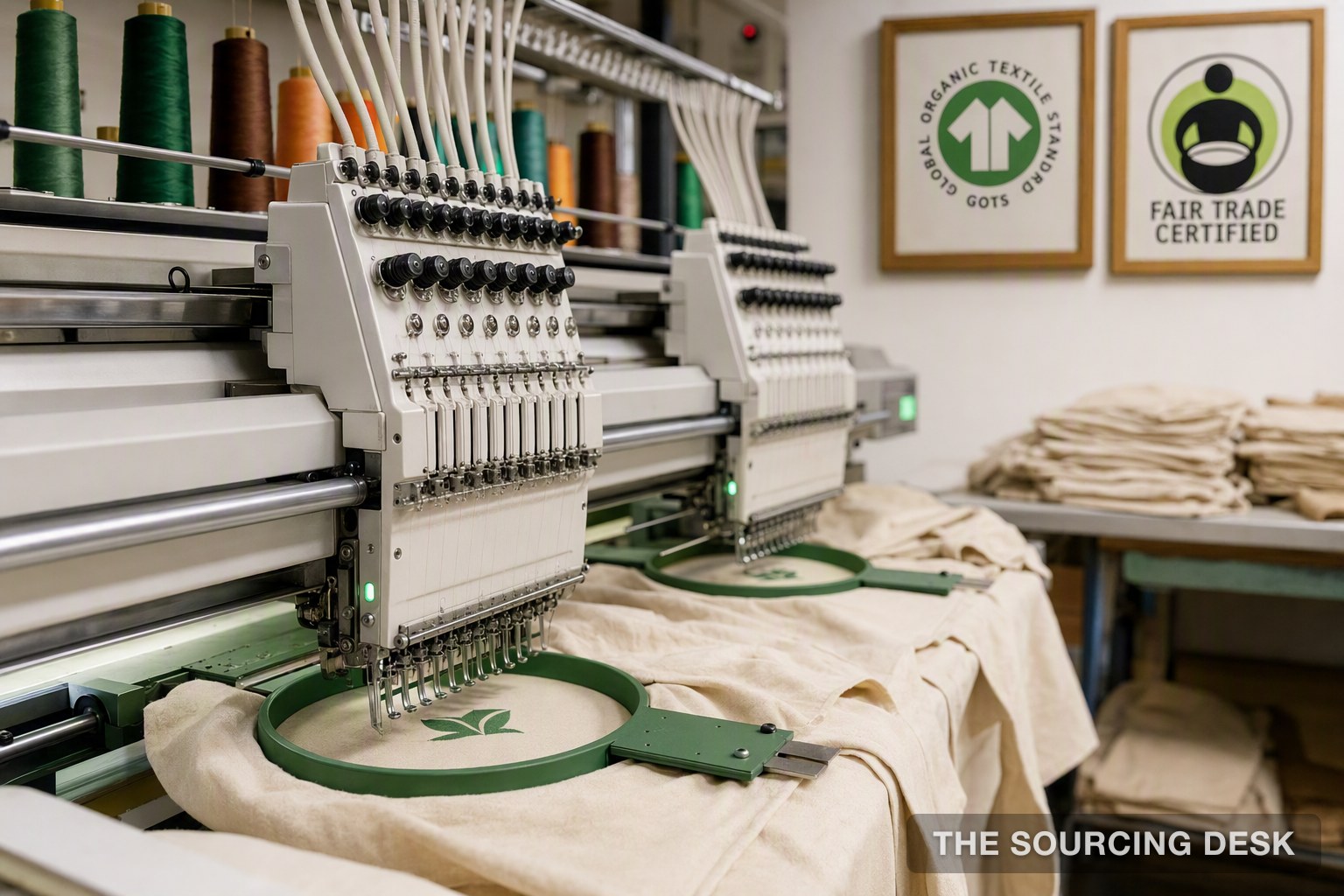
4 Top Machine Embroidery Manufacturers in India (2026)
Four machine embroidery manufacturers in India with checkable credentials: Mega Vick Wear (Fair Trade USA, GOTS, SEDEX, audit docs in 48-72h), Mass India (14+ certifications including CTPAT and CPSIA), Yas Apparel (3 machines, 18 heads, 150,000 pcs/month), and Praana Textiles (vertically integrated, GOTS and Fairtrade).
You finally see it live: a sample from your tech pack, the logo stitched tight on organic French terry. It looks cheap. The thread breaks on the second wash, and the manufacturer's "GOTS certificate" turns out to be a low-resolution JPEG with no license number. This scenario costs brands real money in chargebacks and dead inventory every season, and it's a different failure mode from the authenticity problem we covered in hand embroidery sourcing: machine embroidery isn't about verifying craft, it's about verifying capacity, consistency, and compliance at volume.
India's machine embroidery sector can solve this, but only when you can separate genuine production capability from marketing noise. We looked at four manufacturers that combine decorative capability with data you can actually check: certificate numbers, machine specs, and production capacity, rather than a badge on a homepage.
Key Takeaways
- Mega Vick Wear publishes its Fair Trade USA and GOTS audit records for buyer access, with documentation available within 48 to 72 hours.
- Mass India holds over 14 certifications, including CTPAT, CPSIA, and Sedex, clearing most US retail vendor portals in a single audit bundle.
- Yas Apparel runs 3 embroidery machines totaling 18 heads, rated at a combined 150,000 pieces per month, a concrete capacity figure rather than a vague claim of scale.
- Praana Textiles handles embroidery in-house alongside knitting, dyeing, cutting, and sewing, all under GOTS and Fairtrade certification.
- Certified machine embroidery typically carries a 15 to 25% price premium over conventional production, covering traceable inputs and audit costs.
Machine Embroidery Manufacturers Compared
Manufacturer Embroidery Capability Certifications MOQ Region
Mega Vick Wear Full-package, 7-stage QC Fair Trade USA, GOTS, SEDEX 4-pillar Not publicly disclosed New Delhi / Noida Mass India Embroidery across private label and workwear lines 14+, including CTPAT, CPSIA, Higg, GOTS, Sedex 300 pieces/style Tirupur Yas Apparel 3 machines, 18 heads, 150,000 pcs/month Not publicly disclosed Not publicly disclosed Surat Praana Textiles In-house, vertically integrated ISO 9001:2015, SEDEX, GOTS, Fairtrade Not publicly disclosed Tirupur
1. Mega Vick Wear
Mega Vick Wear is a government-recognized Star Export House operating since 1993 from facilities in New Delhi and Noida, with roughly 400 workers across both sites. The factory makes its third-party audit reports buyer-accessible before contract, which removes the most common due-diligence friction point in ethical sourcing.
Embroidery capability A 7-stage quality inspection process covers production from design feasibility through final shipment, part of a full-package manufacturing model rather than embroidery as a standalone service.
Certifications Fair Trade USA paired with GOTS and SEDEX 4-pillar compliance, covering organic fiber traceability, social accountability, and environmental management under one roof. Audit-ready documentation is available within 48 to 72 hours, and every certificate number can be cross-checked against the SCS Global Services registry or the GOTS public database.
Best for Brands that want multi-standard, publicly verifiable compliance with fast documentation turnaround, rather than chasing paperwork from multiple vendors.
2. Mass India
When a US department store sends a 40-page vendor compliance guide, it usually demands a specific stack of credentials: CTPAT for customs security, CPSIA for children's product safety, a Higg Index score for environmental performance. Chasing each from a different factory fragments both your supply chain and your audit budget. Mass India, based in Tirupur, collapses that fragmentation into one vendor.
Embroidery capability Machine embroidery is offered as a customization option across its product lines, including private label programs, workwear, and eco-friendly apparel ranges built on organic cotton, bamboo blends, and recycled polyester.
Certifications Over 14, including WRAP, SA8000, GOTS, CPSIA, Higg Index, Sedex, SLCP, Amfori BSCI, Disney FAMA, CTPAT, and GRS, broad enough to satisfy most mid-tier to premium US retailer screening in a single facility.
MOQ and lead time 300 pieces per style, though the figure can vary by product category.
Best for Brands needing one vendor to clear a long US retail compliance checklist without qualifying multiple factories separately.
3. Yas Apparel
Not every embroidery job runs on a standard single-head setup, and volume changes what a brand needs from a factory. Yas Apparel, based in Surat, publishes a specific, checkable capacity figure rather than a general claim of scale.
Embroidery capability Three embroidery machines totaling 18 heads, paired with laser cutting equipment, rated at a combined capacity of 150,000 pieces per month. Yas Apparel also lists flat, chenille, applique, sequin, and laser embroidery across its capability set, confirming decorative specialization is commercially structured at this facility rather than subcontracted out.
Best for Brands with high-volume orders that need embroidery capacity and turnaround speed to match, particularly for designs spanning multiple decorative techniques in one run.
4. Praana Textiles
Praana Textiles, established in 2017 and based in Tirupur, runs a vertically integrated model where embroidery sits inside the same production chain as knitting and dyeing rather than being handed off to a separate subcontractor.
Embroidery capability Embroidery is handled in-house alongside spinning, knitting, dyeing, cutting, and sewing, all under one roof, which keeps a garment inside a single certified production chain from raw material to finished piece.
Certifications ISO 9001:2015, SEDEX, GOTS, and Fairtrade.
Best for Brands that want embroidery combined with vertically integrated, GOTS and Fairtrade-compliant knitwear production, where keeping every stage under one certified roof matters for supply-chain traceability.
Verifying Certification and Compliance Claims
A certification claim on a manufacturer's website is not verification. Run these checks before committing production capacity:
- Request the Sedex or SLCP audit ID. A legitimately certified operation provides this within 48 to 72 hours, since the ID is a standard document, not a confidential negotiation lever.
- Check the ID on the platform itself. Log into the Sedex platform or the SLCP Gateway, enter the ID, and confirm the facility name, address, and audit scope match what the manufacturer represented. A scope mismatch, for example an audit covering woven shirts but not the knit blanks your embroidery needs, invalidates the claim for your product.
- Verify the GOTS license number directly in the official GOTS public database. Certificates expire annually, and a certification body can suspend or terminate a license after unresolved non-conformities.
- Confirm Fair Trade status on the SCS Global Services registry, and ask which worker committee manages the premium funds and how the previous year's allocation was spent. A factory that can describe the committee's composition and recent allocations is running the program as designed; one that deflects likely isn't.
- Check Star Export House status through India's DGFT if the factory claims it. This is a performance credential based on multi-year export volume, not a labor or environmental compliance credential, and it correlates with smoother customs clearance rather than ethical sourcing practices.
Red flags worth treating as a stop sign, not a scheduling issue:
- A certificate image with no visible license number, or a proprietary dashboard with no link to a third-party platform
- A documentation request met with deflection, a demand for a deposit first, or a blanket refusal
- A quote priced below the standard 15 to 25% premium band for certified production, with no itemized breakdown of where the certified-input cost went
- No worker committee for Fair Trade premium allocation, with management alone deciding how any social premium is spent
Budget two to three business days to receive the IDs you request, and one more day to verify them against the relevant registry.
Conclusion
India's machine embroidery sector offers real decorative capability, regional specialization, and a compliance infrastructure that's checkable if you know where to look. Among the four manufacturers compared here, Mega Vick Wear and Mass India lead on registry-verifiable multi-standard certification, Yas Apparel offers a concrete, high-volume capacity figure for embroidery-heavy orders, and Praana Textiles keeps embroidery inside a vertically integrated, GOTS and Fairtrade-certified production chain. Whichever fits your order, the verification steps are the same: run the audit IDs, check the registries, and build your supply chain on documented performance rather than a certificate image with no license number attached.
Frequently Asked Questions
::: faq-item
What certifications should I look for when choosing a machine embroidery manufacturer in India for the US market?
Prioritize GOTS for organic fiber traceability and SEDEX or WRAP for social compliance. If your product enters major US retail, add CTPAT for customs security and CPSIA for children's product safety requirements. :::
::: faq-item
How can I independently verify the ethical and sustainability credentials of an Indian apparel factory?
Request the factory's SEDEX or SLCP audit ID and check it on the respective platform. For GOTS, enter the license number into the official public database. For Fair Trade, confirm the facility on the SCS Global Services registry and ask about the worker premium committee. :::
::: faq-item
How do Fair Trade premiums and worker committees function in certified Indian apparel facilities?
A democratically elected worker committee manages the Fair Trade premium funds paid by buyers. The committee decides how to allocate the money, often toward healthcare, education, or community infrastructure. Ask the factory to describe the committee's composition and recent allocations. :::
::: faq-item
What is a Star Rated Export House in India and why does it matter for US buyers?
A Star Export House is a status granted by India's DGFT based on multi-year export performance. For US importers, it correlates with operational reliability and can lead to fewer random customs examinations at US ports, accelerating clearance. :::
Sources
- From Sketch to Sample: How Ethical Low-MOQ Production Solves the Embroidery Branding Puzzle - www.megavickwear.com
- Best GOTS Textile Manufacturers for Small Brands (2026) - www.megavickwear.com
- How to Choose an Ethical Clothing Manufacturer (2026) - www.megavickwear.com
- Yas Apparel: Premium Knitted Garments & Fabrics - www.yasapparels.com
- Eco Friendly Apparel Manufacturer In India - Mirthuni Apparel - massindia.in
Last verified: 2026-08-11