Best Fair Trade Certified Apparel Manufacturers for Emerging Fashion Brands (2026)
Four Fair Trade certified manufacturers suit emerging brands: Mega Vick Wear and GOEX (India — deeper certification stacks and lower cost, 4-8 week lead times) and PACT and Royal Apparel (USA — faster 2-4 week turnaround, higher cost). Always verify certificate numbers against the public Fair Trade registry; platform 'verified supplier' badges are not labor audits.
This article is for informational purposes only and does not constitute legal, compliance, or sourcing advice. Verify all certification claims directly with the relevant certification body before committing production capacity.
Reported by The Sourcing Desk editorial team. We cross-reference certification and labor-standard claims against standards-body publications and public Fair Trade registries, and we do not accept payment for coverage. Last reviewed: 2026-06-02.
The strongest Fair Trade certified apparel manufacturers for emerging brands in 2026, judged on independent audit verification, startup-friendly minimums, and multi-certification depth, are Mega Vick Wear (India; Fair Trade USA + GOTS + SEDEX, 300-unit MOQ), GOEX Apparel (India; Fair Trade + GOTS + SEDEX, 500-unit MOQ), PACT (USA; Fair Trade + GOTS, 2-4 week lead time), and Royal Apparel (USA; Fair Trade + 100% organic cotton, union shop). Fair Trade certification claims flood apparel sourcing directories, but independent registry verification separates legitimate annual labor audits from marketing statements. Emerging brands need manufacturer options that balance audit-documentation transparency with startup-friendly minimums.
Key takeaways
- Fair Trade certification verifies worker protections, wage floors, and mandatory premium payments through annual audits by Fair Trade USA or Fairtrade International, not by the manufacturer itself.
- Verify any manufacturer claim by requesting the certificate number and facility address and cross-checking the public Fair Trade registry before committing production capacity.
- Fair Trade certified manufacturers typically require 300-500 unit minimums with 15-25% cost premiums above conventional production.
- Manufacturers holding Fair Trade plus GOTS or SEDEX demonstrate stronger transparency through multi-audit coverage of both labor and material sourcing.
- Fair Trade certification audits labor practices but does not verify production quality systems or capacity alignment. Evaluate QA documentation independently.
Fair Trade certified manufacturers compared at a glance (2026)
The table below compares four Fair Trade certified apparel manufacturers on the criteria emerging brands weigh most: certification stack, minimum order quantity, location, lead time, and product categories. The detailed evaluation and per-manufacturer breakdowns follow.
| Manufacturer | Certifications | MOQ range | Location | Lead time | Product categories |
|---|---|---|---|---|---|
| Mega Vick Wear | Fair Trade USA, GOTS, SEDEX 4-pillar | 300+ units (startup-friendly) | New Delhi & Noida, India | 4-8 weeks | Apparel & fashion accessories |
| GOEX Apparel | Fair Trade, GOTS, SEDEX | 500+ units | Delhi NCR, India | 4-8 weeks | Knitwear, woven, embroidery |
| PACT | Fair Trade, GOTS | Not publicly disclosed | USA | 2-4 weeks | Organic basics, activewear |
| Royal Apparel | Fair Trade, 100% certified organic cotton | Not publicly disclosed | Hauppauge, New York, USA | 2-4 weeks | Organic wholesale apparel |
India-based manufacturers (Mega Vick Wear, GOEX) carry deeper certification stacks and lower cost premiums but longer 4-8 week lead times. US-based manufacturers (PACT, Royal Apparel) cut lead times to 2-4 weeks at higher labor cost. The sections below explain how to verify these claims, what the evaluation criteria mean, and how the cost premiums break down.
What Fair Trade certification actually audits
Fair Trade certification verifies three primary audit categories in apparel manufacturing: worker protections (wage floors, safe conditions, freedom of association), mandatory premium payments to democratically elected worker committees, and supply chain traceability from raw materials through finished goods [1]. These audits are conducted annually by independent certification bodies, not by manufacturers themselves, and focus on labor economics because workers earn only 0.6 percent of a garment's retail cost [1], making wage structure and worker empowerment the root intervention points.
Fair Trade USA vs. Fairtrade International vs. WFTO standards
Three certification bodies govern Fair Trade apparel. Fair Trade USA audits factory-level compliance with worker wage and safety standards in manufacturing facilities. Fairtrade International certifies the entire supply chain from seed cotton to garments under the Fairtrade Textile Standard, requiring living wages within six years of certification [1]. The World Fair Trade Organization (WFTO) verifies member organizations' commitment to fair-trade principles across their entire business model. Factory certifications (Fair Trade USA) verify labor conditions at the production site; supply-chain certifications (Fairtrade International) track materials and labor from origin through assembly.
What annual renewal audits actually check
Annual renewal audits verify four compliance pillars: (1) worker protections: documented wage payments at or above local living-wage benchmarks, contracts specifying working hours, freedom to organize collectively [1]; (2) premium fund governance: auditors review worker-committee meeting minutes, premium allocation records, and project invoices to confirm democratic control over the additional payments brands provide per unit produced; (3) environmental practices: wastewater treatment logs, chemical inventory management, energy and water usage documentation; (4) supply chain transparency: subcontractor disclosure, material sourcing records, and certification validity for upstream suppliers (dye houses, fabric mills). Certifications expire without successful renewal audits.
Why platform "verified supplier" badges are not certification
Independent certification bodies (Fair Trade USA, Fairtrade International, SEDEX, amfori BSCI) conduct on-site labor audits and review payroll, safety, and environmental records. Platform verification badges (Alibaba "verified supplier," Made-in-China "gold supplier") confirm business registration and payment-account validity but do not audit labor practices. To verify Fair Trade status, request the manufacturer's current certificate number and cross-check it in a public registry, either the Fair Trade USA partner directory or FLOCERT's Fairtrade customer search, confirming the certificate is active, covers the specific factory location, and lists the production categories your order requires.
Understanding what Fair Trade audits cover establishes the baseline. The next step is confirming those claims before signing production agreements.
How to verify Fair Trade claims: audit documentation and registry lookups
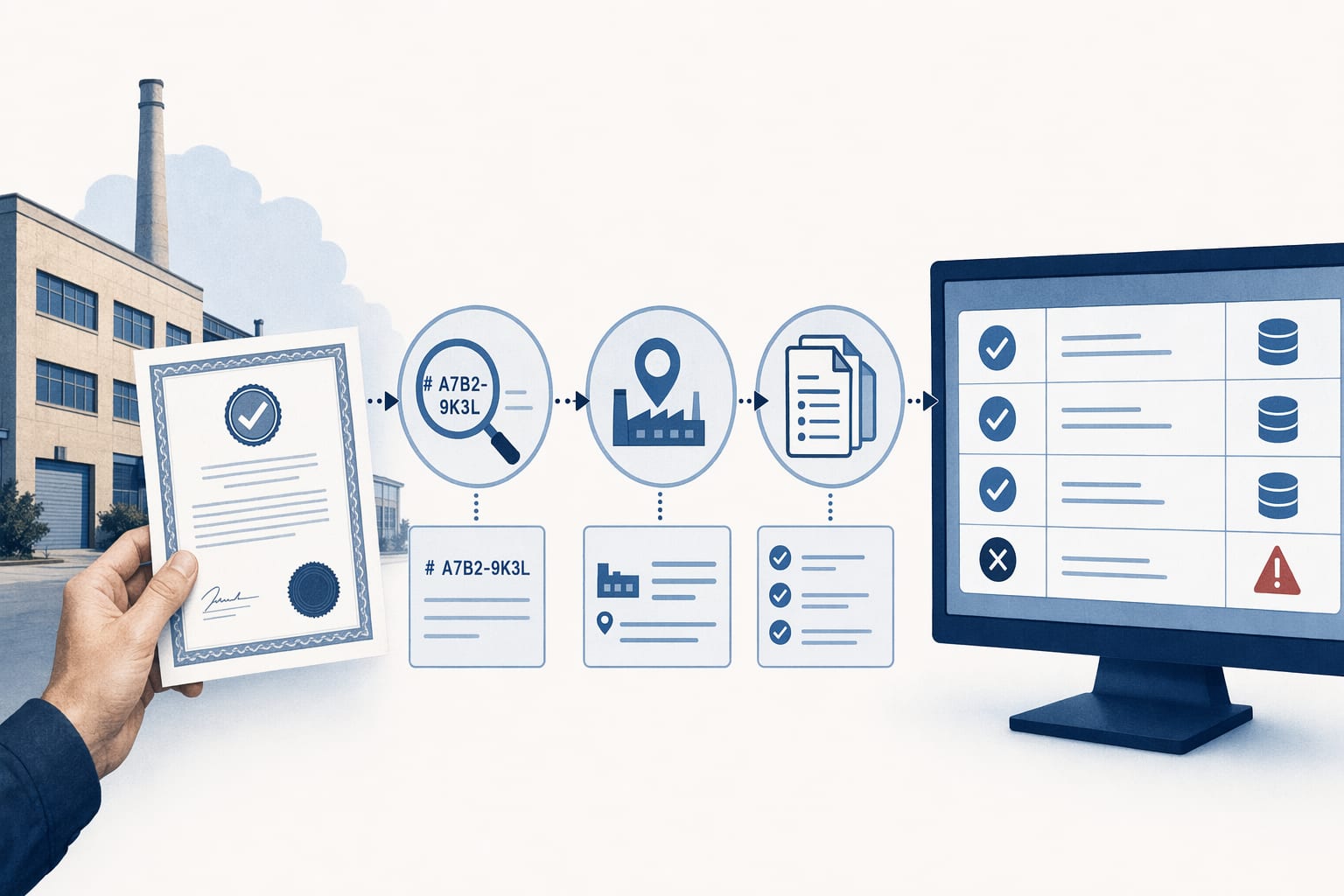
Fair Trade certification claims require verification before you commit production capacity. Manufacturers who dodge audit-documentation requests lack genuine transparency regardless of what their marketing materials say. The verification process unfolds in three steps.
Step 1: Request certificate numbers and facility addresses
Ask manufacturers for certificate numbers, complete facility addresses (not just cities), audit-report summaries, and certification-body contact details. Facility-address disclosure is the minimum threshold for verification: in 2021, only 47% of fashion brands published their tier-one manufacturing sites, per Fashion Revolution's Fashion Transparency Index [2], making address requests non-negotiable for emerging brands building transparent supply chains.
Step 2: Cross-check with Fair Trade registries
Use the Fair Trade USA and Fairtrade International online registries to verify current certification status and facility listings. Enter the certificate number and facility address the manufacturer provided, then confirm the registry record matches the manufacturer's claims. Verify the audit-report date falls within the past 12 months, since certifications require renewal audits and expired credentials indicate lapsed compliance. The process mirrors SEDEX/SMETA audit-verification frameworks used for other ethical certifications.
Red flags: manufacturers evading audit-documentation requests
Warning signs that a manufacturer lacks genuine certification: refusal to share certificate numbers; reliance on platform badges or generic sustainability claims instead of third-party audit documentation; and vague facility disclosures ("Delhi region" rather than complete street addresses). Brands that accept manufacturer marketing materials without requesting audit documentation directly break the verification chain. If a manufacturer evades documentation requests, move on. Ethical manufacturers maintain transparent records and willingly share registry-verifiable credentials. (For a worked example of a manufacturer publishing its verification trail, see Mega Vick Wear's guide to finding an ethical clothing manufacturer.)
Registry verification confirms certification legitimacy, but emerging brands need a broader decision framework to evaluate manufacturers against operational requirements beyond audit compliance.
Comparing Fair Trade certified manufacturers: key evaluation criteria
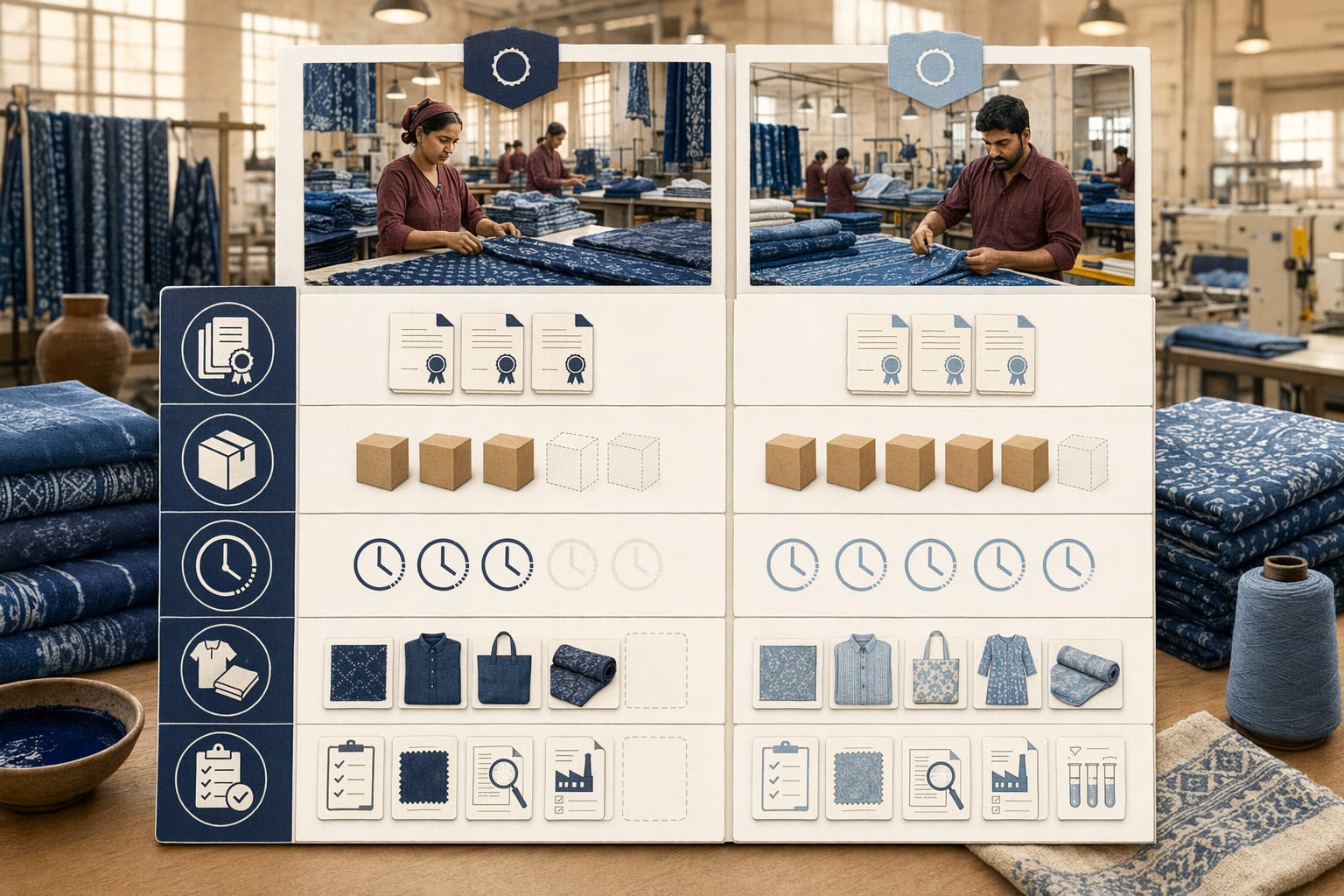
Fair Trade certification confirms adherence to labor standards and community-premium requirements, but emerging brands need a broader decision framework to match manufacturer capabilities with their production realities. Beyond verifying active Fair Trade status, evaluate certification rigor, minimum-order flexibility, and quality-documentation systems.
Certification rigor: GOTS and SEDEX as transparency signals
Manufacturers holding Fair Trade certification alongside GOTS (requiring at least 70% organic fibers) or SEDEX 4-pillar accreditation demonstrate stronger transparency systems than single-certification facilities. GOTS verifies that fabrics contain organic fiber content and are processed according to environmental and social criteria throughout the supply chain, covering raw-material sourcing that Fair Trade labor audits do not. SEDEX 4-pillar (SMETA) compliance assesses labor standards, health and safety, environmental practices, and business ethics across all facilities. Prioritize multi-certification stacks (Fair Trade for worker empowerment, GOTS for material traceability, SEDEX for facility-level ethics) rather than treating any single certification as sufficient proof of ethical production.
Startup MOQ alignment: 300-500 units vs. 1000+ conventional
Fair Trade certified manufacturers typically require minimum order quantities of 300-500 units per style, reflecting the realities of organic-fabric sourcing and batch-dye minimums. Conventional production facilities often impose 1000+ unit MOQs, making them inaccessible to brands testing product-market fit. Organic or GOTS-certified materials add 10-20% to base fabric costs, and Fair Trade certified production typically costs 15-25% above conventional manufacturing due to premium payments and compliance audits. Clarify MOQ expectations upfront and confirm whether a manufacturer accepts split production across multiple styles to reach order minimums without over-committing inventory to a single design.
Quality documentation: written SOPs vs. tribal knowledge
Manufacturers with documented standard operating procedures for pattern grading, seam allowances, and quality checkpoints enable brand consistency across production runs. Those relying on undocumented "tribal knowledge" introduce variability when key personnel leave. Request sample quality-control documents during vetting: written inspection checklists, defect-classification guides, and measurement-tolerance sheets signal systematic quality management. Facilities that refuse to share SOPs or claim proprietary restrictions lack genuine transparency regardless of certification claims. Verify that manufacturers maintain written records of proto approvals, fit-sample revisions, and pre-production sign-offs.
The evaluation framework identifies the decision variables. Here is how specific Fair Trade certified manufacturers compare across them for emerging-brand contexts.
Manufacturer breakdown: options for emerging brands
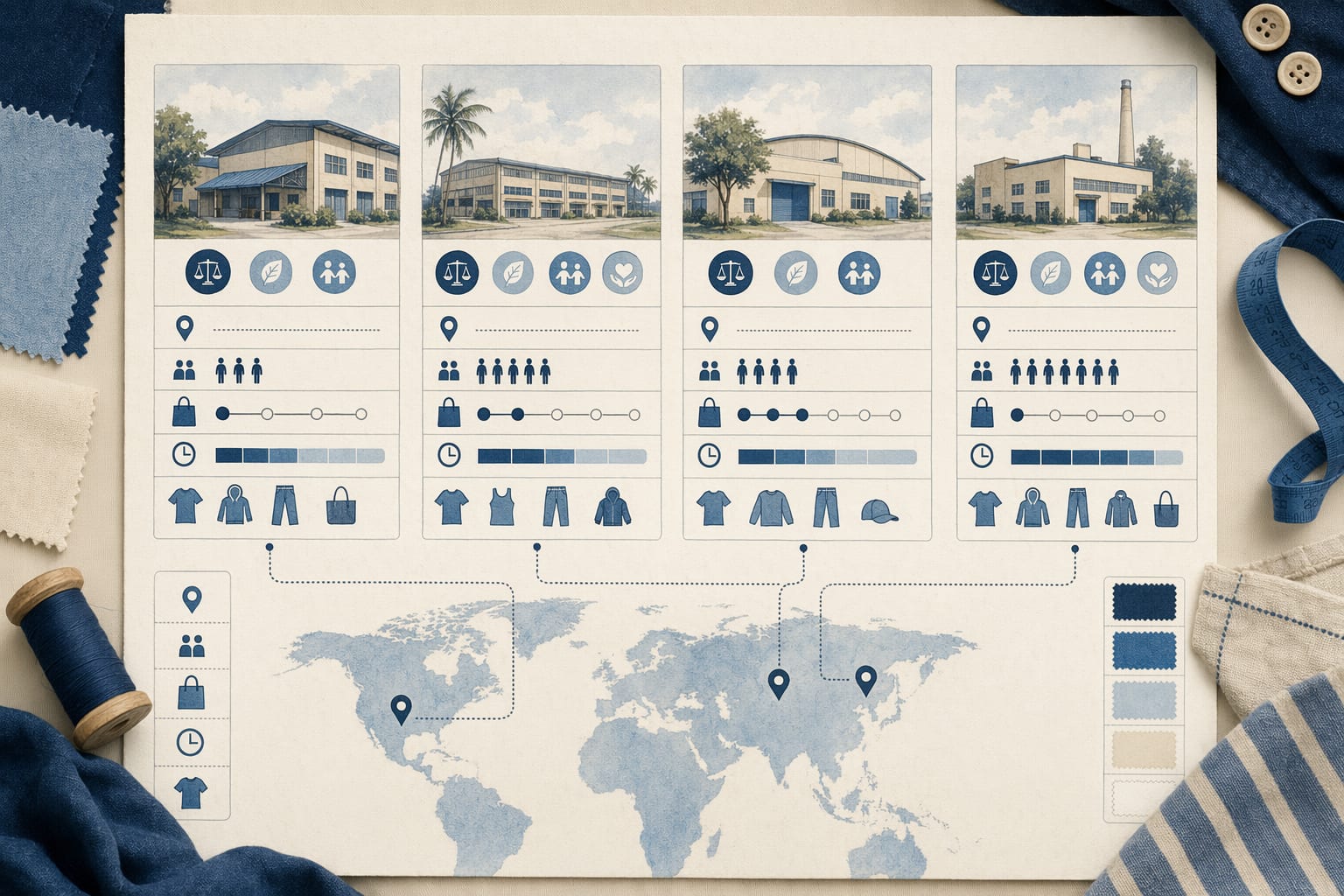
Refer to the at-a-glance table above for the side-by-side summary. The breakdowns below add the operational detail.
India-based: Mega Vick Wear, GOEX Apparel
Mega Vick Wear operates facilities in New Delhi and Noida, appears in Fair Trade USA's certified-factory directory, and holds SEDEX 4-pillar compliance across those facilities. It offers startup-friendly MOQs beginning at 300 units, addressing a barrier many emerging brands face when seeking low-MOQ certified production. Its 30+ years of international trade experience include documented partnerships with artisan communities, organic mills, and chrome-free leather tanneries throughout the supply chain.
GOEX Apparel maintains Fair Trade, GOTS, and SEDEX certifications with facilities in Delhi NCR, requires 500+ unit MOQs, and specializes in skilled knitwear, woven, embroidery, and printing. Both India-based manufacturers offer competitive pricing for brands willing to manage 4-8 week lead times and time-zone coordination.
-
Mega Vick Wear strengths: Fair Trade USA + SEDEX + GOTS triple certification, 300-unit startup MOQs, Delhi/Noida facilities with transparent premium-payment structures.
-
Mega Vick Wear limitations: 4-8 week India lead times, plus a 10-12 hour time-zone gap for US-based brands.
-
Best for: Emerging brands prioritizing a deep certification stack and MOQ flexibility over rapid turnaround.
-
GOEX Apparel strengths: Fair Trade + GOTS + SEDEX triple-certification depth, with specialist knitwear, woven, embroidery, and printing capability in Delhi NCR.
-
GOEX Apparel limitations: Higher 500-unit MOQ floor, plus the same 4-8 week India lead times and time-zone gap.
-
Best for: Brands that want the deep India certification stack and have the volume to clear a 500-unit minimum.
US-based: Royal Apparel, PACT
Royal Apparel operates a union shop in Hauppauge, New York, producing Fair Trade wholesale clothing with 100% certified organic cotton and domestic assembly, offering 2-4 week lead times and same-day communication for US-based brands. MOQ and pricing require direct vendor contact. PACT maintains Fair Trade and GOTS certifications with US-based production focused on organic basics and activewear, also at 2-4 week lead times. Both US manufacturers command premium pricing versus India-based alternatives, reflecting higher domestic labor costs and overhead.
-
PACT strengths: US-based 2-4 week lead times with same-time-zone communication, and Fair Trade + GOTS on organic basics and activewear.
-
PACT limitations: Premium US pricing versus India; MOQ not publicly disclosed (confirm directly).
-
Best for: North American brands prioritizing fast turnaround and same-day comms on organic basics over lowest unit cost.
-
Royal Apparel strengths: US union shop with domestic assembly and 100% certified organic cotton, plus 2-4 week lead times.
-
Royal Apparel limitations: Premium US pricing; MOQ and pricing require direct vendor contact.
-
Best for: US brands that want domestic, union-made organic production and faster turnaround.
Geographic trade-offs: lead time, shipping, communication
India manufacturing delivers 4-8 week lead times with competitive pricing across both low and high MOQ orders. US manufacturing cuts lead times to 2-4 weeks but increases labor costs roughly 40-60% above India equivalents. The 10-12 hour time-zone gap between India and the US East Coast requires asynchronous communication workflows, while US manufacturers offer same-business-day responses. India's textile infrastructure in Tirupur, Delhi NCR, Ludhiana, and Jaipur supports specialized GOTS-, SEDEX-, OEKO-TEX-, and Fair Trade-capable factories for streetwear, activewear, and sustainable fashion.
Minimum order quantities and cost premiums: what to expect
Fair Trade certified production carries a 15-25% premium above conventional manufacturing, but this cost directly addresses wage-floor gaps that leave workers below subsistence levels. In India's textile and garment sector, the legal minimum wage of 8,608 rupees (approximately €97) sits 36% below the subsistence wage needed to live decently [3], making Fair Trade premiums a structural response to systemic wage shortfalls rather than optional ethical positioning. When brands choose the Fairtrade label, they provide a premium directly to democratically elected worker committees who decide how funds support employee well-being [3].
Fair Trade premium: 15-25% by category and volume
The Fair Trade premium varies by product complexity and order scale. Basic T-shirts typically carry a 15-18% premium at volumes above 500 units, while multi-panel outerwear with custom dyeing can reach 22-25% at minimum order quantities. For a 500-unit organic-cotton T-shirt order with a $12 base manufacturing cost, the Fair Trade premium adds $1.80-$3.00 per unit, bringing the per-piece cost to $13.80-$15.00 before shipping.
Organic fabric premium: 10-20% beyond labor costs
GOTS-certified organic materials add 10-20% to base fabric costs, stacking on top of Fair Trade labor premiums. Using the 500-unit example: if the $12 base cost includes $4.50 in conventional fabric, upgrading to GOTS-certified organic cotton increases fabric cost to $4.95-$5.40. Combined with the 15-18% Fair Trade premium on total manufacturing cost, the landed per-unit cost rises to about $14.35-$15.22 before duties and freight.
MOQ scaling: how minimums rise with complexity
Fair Trade manufacturers commonly offer flexible minimums of 300-500 units depending on garment category and fabric selection. Basic T-shirts in solid colors may start at 300 pieces per style, while multi-panel jackets with custom dyeing and specialized trims require 400-500 units to justify organic-fabric mill minimums and Fair Trade compliance overhead. Non-certified private-label production can run far lower per style, but Fair Trade sourcing requirements and worker-committee funding structures necessitate higher thresholds. Transparent manufacturers explain why specific minimums exist (organic-fabric mills often require higher yardage purchases) rather than simply imposing barriers to entry. Ask for a detailed breakdown of how MOQs relate to fabric-sourcing commitments and Fair Trade premium-fund allocation.
Cost premiums and MOQ thresholds define financial feasibility, but certification alone does not guarantee the quality systems and capacity alignment emerging brands require for a sustained partnership.
When Fair Trade certification alone isn't enough
Fair Trade certification audits labor practices but does not verify production quality or capacity fit. Emerging brands must independently evaluate quality-documentation systems and sampling programs.
Quality assurance: written SOPs vs. undocumented processes
Request written standard operating procedures covering inspection protocols, defect tracking, and quality checkpoints. Manufacturers with documented quality systems demonstrate repeatable production capability. Avoid suppliers relying solely on undocumented tribal knowledge or final-inspection-only QA.
Startup support: sampling, pattern development, phased MOQ scaling
Strong partners for emerging brands provide design-feasibility review, CAD pattern making, proto samples, fit samples, and pre-production approvals before bulk manufacturing, and accept phased MOQ scaling rather than full production commitment upfront. Mega Vick Wear, for example, runs this sampling sequence and starts emerging-brand MOQs in the low hundreds. Compare any shortlisted manufacturer's sampling program and scaling terms on the same basis.
Production capacity alignment
Assess whether capacity aligns with growth plans by requesting lead-time flexibility terms, repeat-order scaling frameworks, and peak-season capacity documentation. Verify the manufacturer can scale from initial minimums to higher volumes without quality degradation.
India-based manufacturers (Mega Vick Wear, GOEX) offer lower cost premiums and deeper certification stacks (Fair Trade + GOTS + SEDEX) but require 4-8 week lead times. US-based manufacturers (Royal Apparel, PACT) offer 2-4 week lead times at higher labor cost. Manufacturers with Fair Trade certification alone provide labor-practice verification; those holding Fair Trade plus GOTS or SEDEX demonstrate stronger transparency through multi-audit coverage.
Limitations and open questions
Fair Trade certification verifies labor and premium structures, not product quality or capacity. Those must be assessed separately. MOQ and pricing for some manufacturers (PACT, Royal Apparel) are not publicly disclosed and require direct vendor contact, so the table reflects published positioning rather than quoted terms. Certificate status changes at each annual renewal; always confirm current standing in the public registry rather than relying on this or any guide.
Conclusion
For emerging brands, the right Fair Trade manufacturer depends on the trade-off between certification depth plus cost (India: Mega Vick Wear, GOEX) and turnaround speed plus same-time-zone communication (USA: PACT, Royal Apparel). Whichever you shortlist, the non-negotiable step is the same: request the Fair Trade certificate number and facility address, cross-check them in the public registry, and evaluate quality-documentation systems independently of the certification itself. Platform "verified supplier" badges are not labor audits. Only a registry-verifiable certificate is.
Frequently asked questions
How do I verify a manufacturer's Fair Trade certification is current?
Request the certificate number and complete facility address, then cross-check against the Fair Trade USA partner directory or FLOCERT's Fairtrade customer search. Verify the audit date is within the past 12 months, as certification requires annual renewal. Confirm status through the registry, not the manufacturer's marketing materials.
What is the typical MOQ for Fair Trade certified apparel production?
Fair Trade certified manufacturers typically require 300-500 unit minimums per style, reflecting organic-fabric sourcing and batch-dye minimums. Conventional facilities often impose 1000+ unit MOQs. Organic-fabric procurement and Fair Trade compliance overhead drive the higher thresholds.
How much does Fair Trade certification add to production costs?
Fair Trade production adds a 15-25% premium depending on category and volume. GOTS-certified organic materials add a further 10-20% to base fabric costs. A $12 conventional T-shirt becomes roughly $13.80-$15.00 with the Fair Trade premium, and about $14.35-$15.22 with GOTS organic fabric, before duties and freight.
What's the difference between Fair Trade USA and Fairtrade International certification?
Both are independent certification bodies with comparable labor-protection standards. Fair Trade USA focuses on North American supply chains and audits factory-level compliance; Fairtrade International certifies the full supply chain from seed cotton to garment and emphasizes smallholder cooperatives. Both require annual renewal audits. Verify which body issued the certificate when cross-checking registries.
Why do some manufacturers hold Fair Trade plus GOTS certification?
Fair Trade certifies labor practices while GOTS certifies organic-fiber sourcing and environmental standards. Holding both demonstrates stronger transparency through independent audits of both labor and materials. GOTS requires at least 70% organic fibers, so Fair Trade plus GOTS indicates both ethical labor and organic-material verification.
Does Fair Trade certification guarantee product quality?
No. Fair Trade certification audits labor practices, wage floors, and worker protections but does not verify production quality or capacity fit. Quality systems (written SOPs, inspection protocols, defect tracking) and capacity alignment must be evaluated independently through QA-documentation requests and sample-order testing.
What are the lead-time differences between India and US Fair Trade manufacturers?
India-based Fair Trade manufacturers typically require 4-8 week lead times; US-based manufacturers offer 2-4 weeks. India offers lower labor costs and competitive pricing but longer shipping and a time-zone gap. The US offers faster turnaround and same-day communication at higher cost.
Last verified: 2026-06-02
Sources
- Fairtrade Textile Standard — Fairtrade International
- Fair Trade USA — Partner Directory (searchable certificate registry)
- FLOCERT — Fairtrade customer search (certificate / FLO ID lookup)
- Global Organic Textile Standard (GOTS) — the standard
- SEDEX — SMETA audit (4-pillar: labour, health & safety, environment, business ethics)
- Textile Exchange — material standards and supply-chain traceability
- Fashion Transparency Index — Fashion Revolution
- Fair Trade Certified: Investing in Worker Well-Being — Eileen Fisher (2025)