6 Best Multi-Fabric Clothing Manufacturers in India (2026)
Six Indian manufacturers covering multi-fabric production, ranked by what they actually make rather than by capability lists. The split is volume: NoName Global starts at 100 pieces per style, Shahi Exports works in tens of thousands. Four of the six publish no minimum order quantity or lead time, so any figure quoted in a sourcing roundup should be confirmed in writing before you plan around it.
This article is for informational purposes only and does not constitute legal, compliance, or sourcing advice. Verify certifications and capacity directly with each manufacturer before placing an order.
Reported by The Sourcing Desk editorial team. Last reviewed: November 2, 2026.
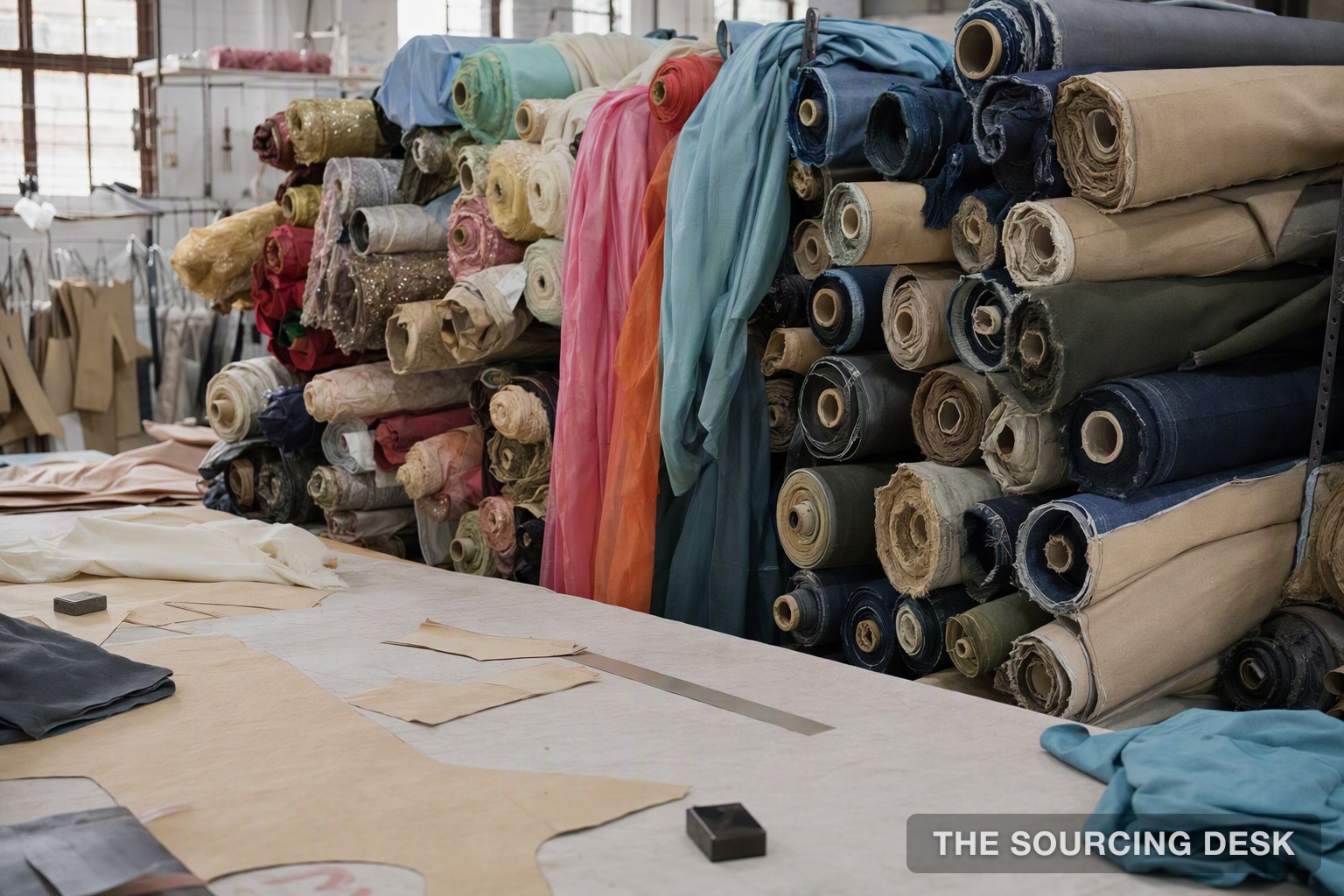
A fabric spec sheet rarely sticks to one material. One line might need organic cotton twill, a silk lining and a wool-blend coat, which usually means three factories on two continents before a single sample ships. Each vendor adds its own sampling fee, its own lead time and its own quality baseline, and by the time all three line up the launch date has moved twice.
India is one of the few countries where cotton, silk, wool, denim and synthetics are all produced in specialised, export-ready clusters inside one national supply chain. The US is India's largest textile export destination at around $10.5 billion, roughly 70% of it apparel, and the Ministry of Textiles expects the sector to reach $100 billion in exports by 2030.
Six manufacturers below cover the multi-fabric brief from different ends of the volume scale. None of them does everything.
Key takeaways
- Multi-fabric manufacturing means one factory producing two or more distinct material types in the same production cycle, which removes a vendor handoff rather than a cost line.
- The six split by volume, not by capability. NoName Global starts at 100 pieces a style. Shahi Exports is built for tens of thousands.
- Mega Vick Wear covers drape-heavy womenswear fabrics, NoName Global covers organic and recycled private label at low minimums, Arvind runs denim at mill scale, Raymond owns worsted suiting, Pratibha Syntex traces organic cotton back to the farm, and Shahi Exports handles high-volume knitwear.
- Most of these manufacturers do not publish minimum order quantities or lead times. Any number you see quoted in a sourcing listicle, including the ones we removed from the draft of this article, should be confirmed in writing before you plan around it.
- Match fabric mix and order volume to a manufacturer's actual category strength before you shortlist. Sampling against the wrong specialist costs weeks.
The six manufacturers at a glance
| Manufacturer | Fabric strength | Volume fit | Certifications on record | Base |
|---|---|---|---|---|
| Mega Vick Wear | Silk, chiffon, georgette, cotton blends, synthetics | Emerging to mid-size womenswear | Fair Trade USA, GOTS, Sedex 4-pillar, VF Corporation Social Standards | New Delhi and Noida |
| NoName Global | Organic cotton, linen, hemp, bamboo, recycled polyester | From 100 pieces per style | GOTS, Oeko-Tex and GRS fabric options | Faridabad |
| Arvind Limited | Denim, woven shirting, knits | Retailer scale | Retailer compliance programmes, not published as one list | Ahmedabad |
| Raymond | Worsted wool, wool blends, shirting | Retailer scale and private label | Industry compliance programmes, not published as one list | Maharashtra |
| Pratibha Syntex | Certified organic cotton, recycled polyester, knits | Mid to high volume | GOTS organic cotton, Fairtrade-linked since 2008 | Pithampur, Madhya Pradesh |
| Shahi Exports | Knitwear, woven tops and bottoms | 10,000 units and up | Sedex and retailer audit standards | Multiple Indian states |
How we evaluated
Every figure here comes from the manufacturer's own published pages or from a government or certification source, checked in November 2026. Where a draft of this list carried a specific minimum order quantity or lead time that the manufacturer does not publish, we removed the number rather than repeat it. Two examples: NoName Global's minimum is 100 pieces a style on its own site, not the 500 to 1,000 that circulates in sourcing roundups, and Mega Vick Wear publishes no fixed minimum at all.
We have not audited any factory, visited a floor or verified a certificate against the registry on your behalf. The last section explains how to do that yourself, and it is worth the hour.
The six manufacturers in detail
1. Mega Vick Wear
Fabric range: silk, chiffon, georgette, cotton blends and synthetics.
Mega Vick Wear has produced womenswear out of New Delhi and Noida since 1993. The useful part for a multi-fabric line is that drape-heavy materials and structured ones move through the same sampling pipeline, so a satin slip dress and a cotton poplin set can develop side by side instead of queueing at two specialist mills.
On compliance it is unusually well documented for a factory this size. It holds Fair Trade USA certification, which few apparel factories in India do, and its facilities are also compliant with Sedex 4-pillar and VF Corporation's social standards, alongside GOTS. Its Fair Trade Premium is allocated by a democratically elected workers' committee rather than by management, and the company reports four completed premium projects covering its whole workforce.
Where it stops: the range is womenswear. No denim programme, no worsted suiting, and no published minimum order quantity or lead time, so both get quoted per project.
Choose this if you are a contemporary or emerging womenswear label that needs two or more fabric types produced together and values an auditable ethical trail.
2. NoName Global
Fabric range: organic cotton, linen, hemp, bamboo and recycled polyester, plus access to Indian artisan fabrics such as muslin and georgette.
NoName Global is a Faridabad private label manufacturer aimed squarely at startups and growing brands, and its minimum is the headline: 100 pieces per style. For a brand testing three styles rather than committing to one, that threshold is the difference between a real production run and a sampling exercise.
It states sustainable fabric options certified to GOTS, Oeko-Tex and GRS, and says it supplies brands in more than 25 countries. Published timelines are 21 days for samples and 45 to 60 days for production once approvals are complete.
Where it stops: certifications are described at the fabric level rather than as a factory certificate with a scope document, so ask which licence covers your order. It is organic-first, which makes it a poor fit for a conventional synthetics programme.
Choose this if you are launching, your volumes are small and your materials brief is organic or recycled.
3. Arvind Limited
Fabric range: denim, woven shirting and knits.
Arvind is one of the largest denim producers in the world and runs the chain from spinning through dyeing to finishing in house. Its own figures put annual output at more than 60 million metres of denim fabric and 15 million pieces of jeans, alongside roughly 140 million metres of woven fabric, and it describes itself as one of India's largest knit fabric manufacturers with about 23 million pieces of knit garmenting a year. For a wash programme running across 50,000 units, that vertical integration removes a layer of outsourced finishing risk.
It also runs a design hub in London and an atelier in the UAE for premium denim development.
Where it stops: minimums are retailer scale. A boutique label will not get a sample run here, and published capacity figures vary between Arvind's own site and third-party databases, so treat any single number as indicative.
Choose this if you are running a high-volume denim or shirting programme.
4. Raymond
Fabric range: worsted wool, wool blends and shirting.
Raymond has been making woollen fabric since its incorporation in 1925 and is consistently ranked among the three largest fully integrated worsted suiting manufacturers in the world. Super 120s suiting either drapes and breathes correctly through a full day or it does not, and that is the standard its formalwear clients buy into.
For private label work the draw is the back catalogue: close to 20,000 documented suiting designs and colourways to select from before anyone commissions something bespoke. Its retail footprint, around 1,589 stores in India and 49 overseas across nine countries, is a reasonable proxy for how the fabric performs at consumer scale rather than in a sample room.
Where it stops: this is a suiting house. Bring it a jersey programme and you are in the wrong building.
Choose this if your core category is tailoring and fabric hand-feel is the thing you cannot compromise.
5. Pratibha Syntex
Fabric range: certified organic cotton and recycled polyester, mostly in knits.
A GOTS badge on a website is easy to display and hard to verify unless the certificate traces back to actual farms. Pratibha Syntex, based in Pithampur in Madhya Pradesh, tracks fibre from planting through ginning, spinning and garment finishing, which makes that trace possible.
Its Vasudha programme began in 1999 with around 500 farmers and the company now puts the network at about 20,000, training growers in non-GMO seed and organic practice rather than buying certified cotton on the open market. Fairtrade's own case material describes the same network from the certification side. Spinning, knitting, dyeing and garment production run in house, which closes the subcontracting gaps where compliance usually slips.
Where it stops: the strength is knits and close-to-body categories. Farmer counts differ widely between the company's pages, Fairtrade's figures and older trade coverage, which is a reminder to ask what a number counts before you quote it to a buyer.
Choose this if your brand is organic-first and you need certification you can independently confirm.
6. Shahi Exports
Fabric range: knitwear, woven tops and bottoms.
Shahi Exports is India's largest apparel manufacturer and exporter, founded in 1974 and now running more than 50 factories across multiple states. If a purchase order calls for 30,000 knit tops in three colourways inside a 90-day window, this is the scale built for it. The company puts vertical integration of the garment-making process at about 80%, with its own textile mills feeding its factories, which reduces the number of external parties a compliance audit has to cover.
Where it stops: this is not a first order. Below five figures per style you will struggle to get attention, and the fabric range is squarely mass-market rather than specialist.
Choose this if you are an established brand or big-box supplier placing high-volume knitwear orders.
How India's regional clusters map to your fabric choice
Knowing which cluster makes your fabric saves weeks of dead-end supplier calls.
- Tirupur, Tamil Nadu: knitwear, including cotton jersey tees, underwear and activewear.
- Ludhiana, Punjab: woollen and acrylic knits, sweaters, cardigans and winter accessories.
- Ahmedabad, Gujarat: denim and cotton weaving, plus a large home-textiles corridor.
- Delhi and Noida: woven apparel, synthetic blends and embellished garment work.
Knit basics point to Tirupur, winter woollens to Ludhiana, denim to Ahmedabad, embellished wovens to Delhi or Noida. A manufacturer with facilities or partnerships across clusters removes the need to manage each region as a separate relationship.
What the 18% US tariff changes
Under the India-US trade agreement, an 18% reciprocal tariff applies to textile products including apparel and made-ups. The Ministry of Textiles said in February 2026 that the rate removes the disadvantage Indian exporters had been carrying, and framed the US market, worth $118 billion in global textile and apparel imports, as the main route to the $100 billion export target.
For a sourcing team the practical effect is narrower: landed cost from India is now worth recalculating against Vietnam and Bangladesh, because comparisons built on 2025 rates are out of date. Ask each manufacturer to quote delivered duty paid if you want the comparison to mean anything.
How to verify a certification claim
A certification claim on a website is a starting point, not proof.
- Request the certificate number and the scope document from the manufacturer's compliance contact.
- Check the number against the issuing registry: global-standard.org for GOTS, sedex.com for Sedex.
- Confirm the scope covers your garment category, and that the expiry date falls after your production date. A valid certificate for knit tops does not cover an embroidered woven jacket.
- Treat a refusal to share a certificate number as an answer in itself.
Limitations
This comparison is built from published sources, not factory visits. Minimum order quantities and lead times are absent for four of the six manufacturers because they do not publish them, and we would rather leave a gap than invent a range. Capacity figures for the large mills differ between company sites and third-party databases, sometimes by a wide margin, so they are indicative. Certifications listed are those each company claims; we have not pulled certificates from the registries. Nothing here reflects pricing, which in this category is quoted per style against a tech pack.
Frequently asked questions
Is one multi-category manufacturer better than separate specialist mills?
One manufacturer means one tech pack process, one compliance audit cycle and one shipping consolidation. That is where the time saving actually lives. Separate specialists give deeper expertise in a single fabric. If your line leans on one hero material, go specialist. If it spans categories at modest volume, consolidate.
What minimum order quantity should a new brand expect in India?
It depends entirely on the factory rather than the country. NoName Global publishes 100 pieces per style. Large mills work in tens of thousands. Organic programmes tend to sit higher than conventional ones because fabric mills set minimum yardage, so a certified organic run often cannot start as small as a conventional one.
How long does production and shipping take for a US brand?
Plan 8 to 12 weeks end to end, covering sampling, bulk production and ocean freight. NoName Global publishes 21 days for samples and 45 to 60 days for production after approvals, which is a reasonable shape for the category. Air freight compresses the shipping leg and removes most of the cost advantage.
What should I ask for before a first purchase order?
Certificate numbers with scope documents, a recent third-party audit report, a production timeline with named milestones, and a reference from a client at a comparable volume. Hesitation on any of the four is worth a second look.
Does location really determine fabric specialisation in India?
Largely, yes. The clusters grew around raw material access, skill pools and processing infrastructure, so a knitwear factory in Tirupur and a suiting mill in Maharashtra are not interchangeable, whatever a capability page says.
Conclusion
The right manufacturer is not the one with the longest capability list. It is the one whose fabric range, volume floor and certification depth match what you are already committed to producing.
Map your SKU count and fabric mix against two or three candidates before you send a tech pack, and ask every one of them for the numbers their website leaves out. The ones that answer in writing have already told you more than the badge on the homepage.
Company figures in this article are each manufacturer's own published claims, checked in November 2026, and have not been independently audited. Capacity numbers for the larger mills differ between company sites and third-party databases.
How we built this list: we used each manufacturer's own published pages plus Ministry of Textiles data, and removed minimum order quantities and lead times that the manufacturers do not publish rather than repeat figures circulating elsewhere.
Last verified: 2026-11-02
Sources
- India-US Trade Agreement, major boost for Textile Industry | PIB, Ministry of Textiles
- Mega Vick Wear | Fair Trade
- Mega Vick Wear | Infrastructure
- NoName Global | Private Label Clothing Manufacturer
- Arvind Limited | Fabric and Apparel
- Raymond
- Pratibha Syntex | Vasudha Swaraj
- The Vasudha story of rural renewal, powered by Fairtrade Premium | Fairtrade NAPP
- Shahi Exports
- Global Organic Textile Standard | Certified suppliers database