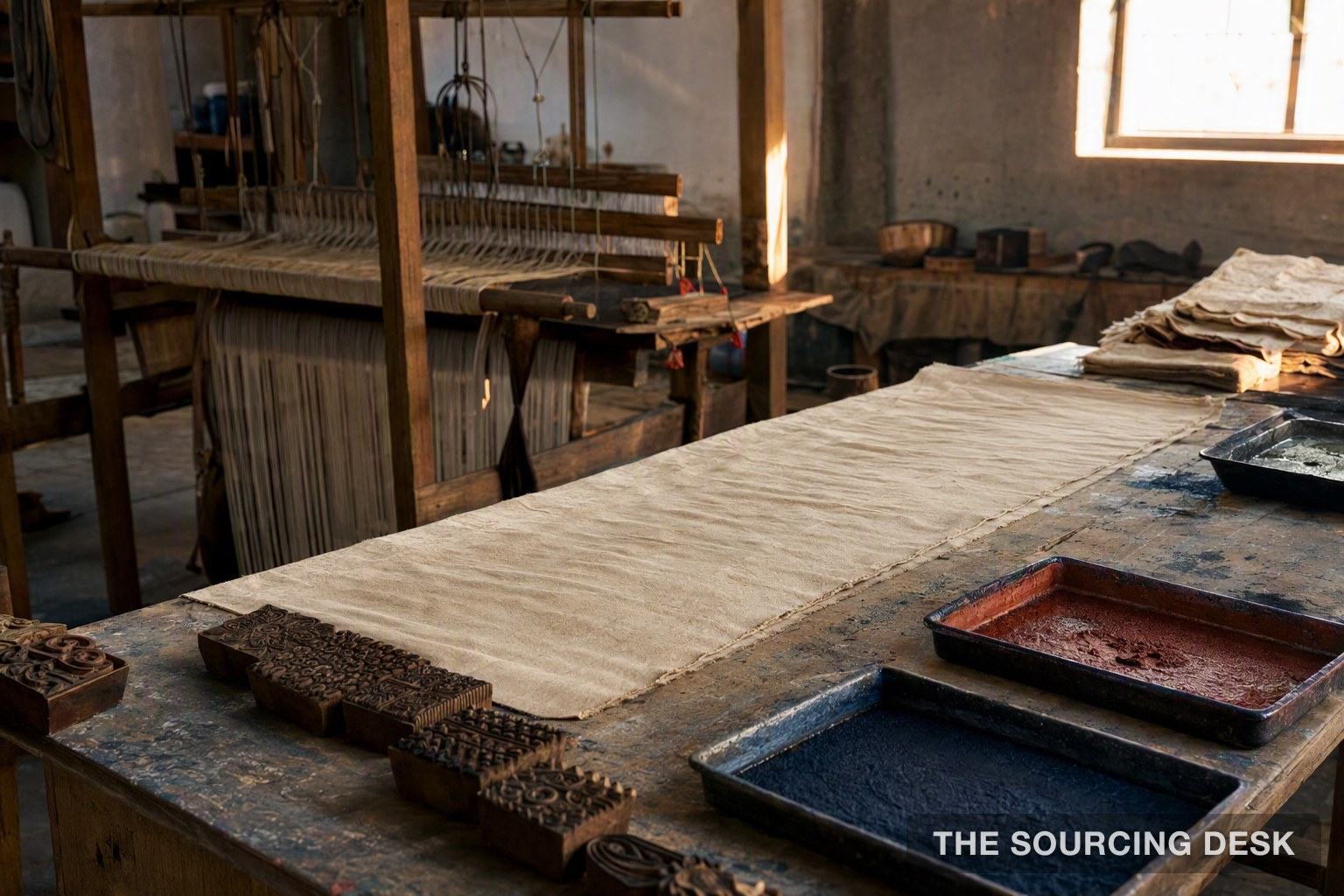
4 Ethical Factories for Premium Boho Brands (2026)
Four India-based factories for premium boho lines: Mega Vick Wear (woven and knit, flexible MOQs), Mehera Shaw (hand block printing), Five P Venture (handloom and natural dyes), Billoomi Fashion (embroidery, from 25 pieces). Certification confirms labor and environmental standards, not craftsmanship, so check the two separately. Every certification listed is as stated by the factory: confirm the number, scope, and expiry in the issuing registry before you contract.
Premium boho brands need two things from a factory, and they are checked separately: certification you can look up in a public registry, and genuine artisanal capability on the floor. Four India-based options cover different ground: Mega Vick Wear for woven and knit apparel with flexible MOQs, Mehera Shaw for hand block printing in Jaipur, Five P Venture for handloom weaving and natural dyes in Tamil Nadu, and Billoomi Fashion for embroidery and print at minimums as low as 25 pieces. Certification does not imply craftsmanship: a GOTS or Fair Trade certificate says nothing about whether anyone on site can dress a loom or cut a block. Every certification named here is as stated by the factory, so confirm the certificate number, scope, and expiry in the issuing body's registry before you contract.
Key takeaways
- Premium boho sourcing asks two separate questions at once: can this factory actually do the craft, and can its certification be checked in a public registry? A factory can pass one and fail the other.
- Certification does not imply craftsmanship. GOTS and Fair Trade confirm environmental and labor standards, not whether anyone on site knows how to cut a block or dress a handloom.
- MOQs move with technique, not with the factory. At Billoomi Fashion, non-custom styles start as low as 25 pieces per style and color; the floor jumps to 100 for custom printed or embroidered work. Hand-led production at Mehera Shaw and Five P Venture runs in small to medium batches rather than fixed unit minimums.
- The four factories below cover four different specialties: woven and knit apparel (Mega Vick Wear), hand block printing (Mehera Shaw), handloom weaving and natural dyes (Five P Venture), and hand and machine embroidery, block printing, and smocking with low minimums (Billoomi Fashion).
- Treat any single-source claim as unverified. Every certification named here is as stated by the factory, and it is on you to confirm the certificate number, scope, and expiry in the issuing body's registry before you sign anything.
Ethical factories in India for premium boho and boutique brands
If you're building a premium boho line, you already know most "ethical" factory lists won't actually work for you. Volume-focused Fair Trade manufacturers are built for basics, not the embroidery, block printing, and handloom weaving your designs need. Every factory claims to be ethical and artisan-made, and very few of those claims hold up once you check them.
You need a factory that can do both: real artisanal craftsmanship and certification you can verify yourself. This guide walks through what to look for, then profiles four factories in India whose credentials are specific enough to be checkable.
| Factory | Certification (as stated by the factory) | Specialty | Location |
|---|---|---|---|
| Mega Vick Wear | Fair Trade USA, SEDEX 4-pillar | Woven and knit apparel, flexible MOQs | New Delhi and Noida |
| Mehera Shaw | WFTO Guaranteed Member | Hand block printing, organic cotton | Jaipur |
| Five P Venture | GOTS certified | Handloom weaving, natural dyes | Tamil Nadu |
| Billoomi Fashion | ISO 9001:2015, SEDEX audited | Embroidery, block printing, low MOQ | Delhi NCR |
The certifications in this table are as stated by each factory. They are not claims this article has independently verified, and you should confirm each one in the relevant registry before contracting. For organic fiber and processing claims, that means looking the company up in the GOTS certified suppliers database and checking that the certificate is current and that its scope covers the product category you plan to order.
What to look for in an ethical factory for boho and premium lines
Before you reach out to anyone, you want a short filter that separates real partners from marketing pages. Four things:
Artisanal capability. Hand block printing, embroidery, handloom weaving, or natural dye work, done by people who do it regularly. Machine production dressed up in artisanal language is a different product.
Certification you can look up yourself. A certificate number or a registry listing beats a logo on a homepage. If the factory can't tell you which body issued it and when it expires, you have nothing to check.
MOQ flexibility. Boutique-scale premium runs, not just bulk basics. Ask whether the minimum is per design or per order, because those are very different numbers.
A documented production history. Named client relationships, import and export records, shipment data. Case study photos are not evidence of scale.
The four factories below were shortlisted because each publishes enough specificity on all four to be worth a conversation.
Factory profiles
Mega Vick Wear
Mega Vick Wear manufactures woven and knit apparel out of New Delhi and Noida, and says it has been doing so since 1993.
Certification: The company lists Fair Trade USA certification and SEDEX 4-pillar compliance, and states that this meets VF Corporation's social standards. That last part is a company-stated claim about a specific corporate buyer's programme, so treat it as a starting point for a conversation rather than a settled fact, and ask for the certificate numbers and audit dates behind both listings.
Specialty: Woven and knit apparel, backed by what the company describes as a vetted supply chain covering artisan communities, organic mills, and chrome-free leather tanneries.
MOQ: Described as flexible, with room to scale order volumes as a line grows rather than forcing a factory change mid-season.
Scope caveat: Its listed strength is breadth, woven and knit apparel with a vetted supply chain behind it, rather than depth in one specialist craft. It is not positioned the way Mehera Shaw is around hand block printing or Five P Venture is around handloom weaving. If your collection is built on one of those techniques specifically, confirm that exact capability, and whether it is in-house or subcontracted, before you commit.
A sensible starting point for brands that need certified compliance across a mixed woven and knit range and want room to grow volumes without changing factories.
Mehera Shaw
Mehera Shaw is built around one craft: hand block printing using traditional Rajasthani techniques, including the Bagru dye process.
Certification: The company lists itself as a WFTO Guaranteed Member (#1047). WFTO membership covers an organization's overall fair trade practices rather than a specific product line, and current member status is searchable through the World Fair Trade Organization.
Specialty: Hand block printing on organic cotton, using AZO-free, low-impact dyes throughout production.
MOQ: Small to medium-batch production, aimed at independent designers rather than bulk runs.
Scope caveat: The specialism cuts both ways. A factory this focused on block printing is unlikely to cover embroidery, knits, or woven fabric development, so a collection that mixes techniques will probably need a second supplier. Batch sizes skew small too, which is a constraint if you are planning a large launch.
The obvious fit for a label whose core is hand block printing and wants a maker who has spent decades doing exactly that.
Five P Venture
According to its own materials, Five P Venture was founded in 2013 specifically to revive handloom weaving traditions in Chennimalai, Tamil Nadu.
Certification: The company states that it is GOTS certified. Since GOTS covers organic fiber content and environmental processing across the supply chain, and since certificates carry both an expiry date and a defined scope, look the company up in the GOTS certified suppliers database and confirm the listing covers the fabric and product type you want.
Specialty: Handloom textiles and natural dyes, working with organic cotton, linen, Tencel, and peace silk. According to its own materials, production runs in a 100% solar-powered studio staffed by 22 full-time artisan weavers and 10 tailors.
MOQ: Positioned for premium and luxury brands and boutiques rather than mass retail.
Scope caveat: By the company's own numbers, this is a small team, and handloom weaving is slow by nature. A studio of that size will not absorb a large order or a fast turnaround, so check capacity against your launch calendar early. Ask what a realistic weekly meterage looks like before you design around the fabric.
Makes most sense when handloom cloth and natural dye work are the foundation of the line, not a detail added for marketing purposes.
Billoomi Fashion
Billoomi Fashion is a full-service Delhi NCR factory. The company says it has over 15 years of experience and has served 300+ clients across 18+ countries.
Certification: It lists ISO 9001:2015 certification and SEDEX audits, and says it sources fabric through GOTS and OEKO-TEX certified mills. Read that carefully: mill certification covers the cloth, not necessarily the garment factory's own operations. Ask which certificate number applies to your specific fabric and check it against the issuing body's database.
Specialty: Hand and machine embroidery, block printing, and smocking, with eco-friendly fabric options including organic cotton, Tencel, bamboo, and recycled polyester.
MOQ: As low as 25 pieces per style and color, with a 100-piece minimum for custom printed or embroidered styles.
Scope caveat: ISO 9001:2015 is a quality management standard. It says something about process consistency and nothing about labor conditions or environmental impact, so the social side here rests on the SEDEX audit, whose scope and date you should ask for directly. The low headline MOQ also jumps fourfold the moment you customize the print or embroidery, which is worth planning around.
Suited to newer or smaller premium brands that cannot commit to large runs but still need embroidery, block printing, or smocking done properly.
How to verify a factory's ethical claims before you commit
A certification badge on a homepage tells you what a factory is claiming, not what is true. Before you commit production capacity anywhere, boho-focused or otherwise, run these checks.
Look for independent confirmation. Search for the factory as a named partner on other brands' sites, not just its own. Unrelated brands listing them as a supplier is a far stronger signal than a logo.
Check certification scope and expiration. Fair Trade, GOTS, and WFTO certifications all require periodic renewal, and coverage is often limited to specific product categories. The GOTS certified suppliers database, Fair Trade Certified, and the World Fair Trade Organization all publish searchable listings. Confirm the certificate actually applies to what you're ordering, then confirm it hasn't lapsed.
Look for a real production history. Import and export records, shipment data, and named clients tell you a factory operates at the scale it claims.
Treat single-source claims with caution. If a certification or partnership claim appears only in the factory's own materials and nowhere else, it is unconfirmed until you verify it yourself. That applies to every claim in this article too.
What each certification actually covers
Most of the confusion in ethical sourcing comes from treating certifications as interchangeable badges. They audit different things, on different units of measurement, and a factory can hold three of them and still fall short on the thing your collection depends on. Here is what each scheme named in this article actually covers, and what it leaves untouched.
| Certification | What it certifies | What it does NOT tell you | Where to verify |
|---|---|---|---|
| Fair Trade USA | Labor standards, safe working conditions, and a Community Development Premium, assessed at the facility or product level | Nothing about organic fiber content, and nothing about whether anyone on site can do craft work | Fair Trade Certified |
| WFTO (Guaranteed Member) | An organization's overall fair trade practice, assessed across the whole business | It is not a product certification, so it confirms neither fiber content nor that a specific product line was made under it | World Fair Trade Organization |
| GOTS | Organic fiber content, plus environmental and social criteria carried through processing | Nothing about fair trade pricing, and nothing about craft technique | GOTS certified suppliers database |
| OEKO-TEX Standard 100 | The finished textile, tested for harmful substances | Nothing about organic content, labor practice, or craft | OEKO-TEX |
| SEDEX (SMETA 4-pillar) | An audit methodology covering labor, health and safety, environment, and business ethics | It is an audit, not a certification, so there is no pass/fail seal; results are shared between members on the SEDEX platform | Ask the factory directly for the SMETA report and its audit date |
| ISO 9001:2015 | A quality management system standard | It contains no social or environmental requirements at all | Check the certificate with the issuing certification body |
Two further things apply to all of them. Scope is defined per site and per product category, so a certificate covering one unit does not automatically cover a second unit, and one covering woven apparel does not automatically cover knitwear. Every scheme here also runs on a renewal cycle, which means a certificate that was genuine two years ago may have lapsed since. Both facts are printed on the certificate itself, which is why asking for the document beats accepting the logo.
Read down the middle column and the gap is hard to miss: none of these certify artisanal craftsmanship. No registry anywhere will tell you whether a factory's printers can hold registration across a repeat or whether its embroiderers can execute your artwork, so craft capability has to be assessed separately, through samples and through direct questions about who does the handwork.
Questions to ask before committing to a factory partnership
Once you've shortlisted, these questions reveal how a factory actually operates.
What's your sample turnaround time? Hand block printing and embroidery take longer than machine production, so get a realistic timeline before you build a calendar around it.
Is your MOQ per design or per order? This changes how many styles you can launch on a limited budget.
Does your certification cover the product category I'm ordering? A certificate for woven apparel does not automatically cover knits, and vice versa.
Can you share documentation on your artisan sourcing? Ask specifically how embroidery, block printing, or handloom work is sourced, and whether it happens in-house or gets subcontracted.
What does your standard SOP and communication process look like? This tells you how the partnership runs day to day, which matters more over a season than how the first sample turns out.
How the MOQ number actually gets counted
The headline minimum is rarely the number you end up committing to. MOQ is usually quoted per style and per colorway, so one dress in three colors is three minimums rather than one, and a modest-sounding 50-piece floor turns into 150 units of commitment. Underneath that sits the mill's fabric minimum, which can be higher than the factory's garment MOQ and quietly becomes the real floor for anything that uses a fabric the factory does not already hold in stock. Custom print or custom embroidery normally carries a higher minimum than a plain style, because blocks, screens, or digitized files have to be made before the first piece exists. Ask for all three numbers separately: per style, per colorway, and the fabric minimum sitting behind them.
Lead times and sampling for artisanal production
Hand-led production runs on a different clock, and most calendar problems in premium boho sourcing come from planning a hand-printed or handwoven collection on machine-production assumptions.
The reason is structural rather than a matter of factory efficiency. Every unit passes through a skilled pair of hands at least once, usually several times. Hand block printing means a printer placing a carved block against cloth repeat after repeat, registering each impression by eye, then waiting on dye curing and washing between stages before the next color can go down. Handloom weaving is capped by loom-days: one weaver at one loom produces a certain meterage per day, and the only way to move faster is more weavers or more looms, neither of which materializes mid-order. Hand embroidery behaves the same way. That slowness is what you are paying for, but it needs to sit in the calendar rather than come as a surprise in week six.
Sampling adds a layer of its own. It typically runs in rounds: an initial sample, one or more revision rounds against your comments, then a pre-production sample signed off before bulk begins. Each round is a physical object that has to travel, so an international brand adds a shipping leg, and often a customs step, to every single loop. Two revision rounds that sound trivial on a call can mean weeks of freight in practice. Ask what the factory's own sampling sequence looks like, how many revisions are included before charges start, and who pays the courier in each direction.
Natural dyes bring a shade question worth settling early. Dye lots vary between batches because plant material, water, and process conditions are never identical, and that variation is part of the appeal until a customer places a reorder and expects the exact color they saw the first time. Agree on an approved reference swatch and a shade tolerance you can both live with, in writing, before the first bulk run rather than during the second.
Two seasonal factors sit on top of all of it. Monsoon humidity slows drying, which matters most for printed and dyed goods that need to cure and wash between stages. India's festival calendar, Diwali in particular, thins or closes factories for stretches, and the dates move each year. Neither is a reason to avoid Indian sourcing. Both are reasons to ask, before you fix a launch date, which weeks the factory expects to be running at reduced capacity.
Treat all of this as questions to put to the factory rather than fixed rules. Nobody can honestly quote you a universal number of weeks for hand block printing, because it depends on technique, quantity, colorway count, and season. What you want is the factory's own timeline in writing, broken down by stage, for your specific technique and quantity, plus what happens to that timeline if you add a colorway or an extra revision round.
Greenwashing red flags specific to boho and artisanal sourcing
Artisanal sourcing has its own version of greenwashing, separate from the generic sustainability kind.
Vague "handmade" or "ethical" language with nothing behind it. If a factory can't point you to a specific, checkable certification, read those words as marketing.
No transparency about who does the handwork. Ask directly whether embroidery or block printing happens in-house or gets subcontracted. An unclear answer is an answer.
Certification claims that appear nowhere except the factory's own website. If the claim only shows up in the factory's own materials, or across content clearly written to promote them, that's a red flag rather than confirmation.
Conclusion
Sourcing a boho or premium line means holding two things together: ethical credentials you can verify and artisanal capability that actually exists. Plenty of factories have one without the other.
The four above cover a range of specialties and certification types, which makes them a reasonable starting shortlist depending on what your collection needs. They are not an endorsement. The next step is yours: pull each certificate, confirm it in the issuing registry, check the scope and the expiry, and get a clear answer on how the artisan work is sourced before any of it turns into a purchase order.
Frequently asked questions
What's a realistic MOQ for a premium boho brand sourcing from India?
It depends heavily on technique. At Billoomi Fashion, non-custom styles start as low as 25 pieces per style; the minimum rises to 100 for custom printed or embroidered work. Fully hand-led techniques at factories like Mehera Shaw or Five P Venture typically run in small to medium batches rather than fixed unit minimums.
What's the difference between Fair Trade USA, WFTO, and GOTS certification?
Fair Trade USA certifies labor practices and fair pricing at the facility or product level; current certified organizations are listed at Fair Trade Certified. Fairtrade International (FLO) runs a separate certification system with its own public registry at check.fairtrade.net; a factory certified by one will not necessarily appear in the other's database. WFTO certifies an organization's overall fair trade practices rather than specific product lines, with member status searchable at the World Fair Trade Organization. GOTS certifies organic fiber content and environmental processing standards throughout the supply chain, and its scope is published in the GOTS certified suppliers database. They aren't interchangeable, and a factory can hold one, several, or none of them.
How long do artisanal techniques like block printing or embroidery typically take?
Sample and production timelines for hand block printing, embroidery, and handloom weaving generally run longer than machine production, since they depend on skilled artisan labor rather than automated processes. Confirm specific timelines directly with the factory rather than assuming standard garment lead times apply.
Can a factory be certified and still lack artisanal capability?
Yes. Certification confirms labor and environmental standards, not craftsmanship. A GOTS or Fair Trade certified factory built for basics and volume production may have no hand block printing, embroidery, or handloom capability at all, which is why boho and premium brands need to check certification and specialty as two separate things.
How do I confirm a factory's certification is actually real?
Start with the issuing body's own registry, then look for corroboration outside the factory: other brands listing them as a supplier, independent industry directories, import and export records. A certification claim that appears only on the factory's own website or in promotional content should be treated as unverified until you find outside confirmation.
This article is for general informational purposes only and is not sourcing, legal, or compliance advice. Verify each factory's current certification status, certificate scope, and expiry date directly with the issuing registry and with the factory itself before contracting or placing a purchase order.
Reviewed for accuracy by The Sourcing Desk editorial team. Certification scheme descriptions were cross-referenced against GOTS, Fair Trade USA, WFTO, and OEKO-TEX; all factory-specific claims are as stated by each factory and were not independently verified. Last reviewed: August 3, 2026.
Last verified: 2026-08-03